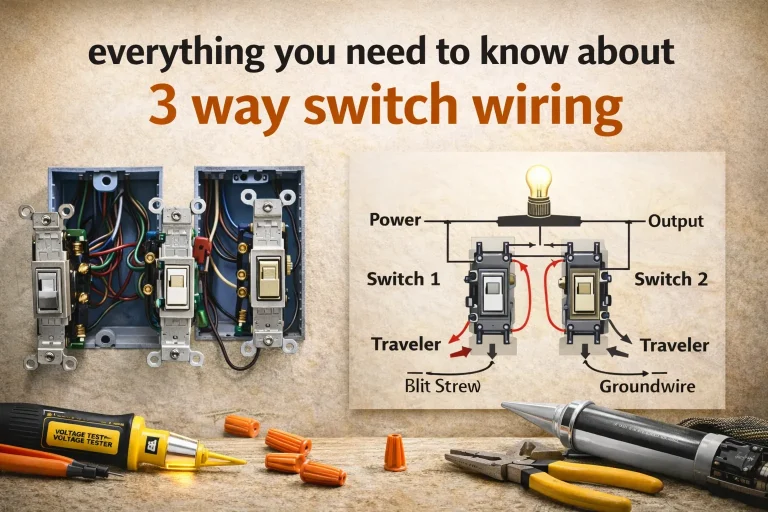
how to wire a light switch
Wiring a light switch is a fundamental DIY skill that can save you a $150+ electrician’s visit. Whether you are upgrading to a modern toggle or replacing a worn-out unit, the process is safe and simple if you follow the correct wiring sequence. This guide provides a pro-approved walkthrough on how to wire a single-pole light switch, identify wire colors, and avoid common safety hazards.
DIY difficulty summary
|
Difficult |
3 / 10 |
|
Time Required |
10 – 30 minutes |
|
Skill Level |
Beginner / Intermediate |
|
Risk Level |
Medium (electrical safety required) |
Tools And Materials Needed
Required Tools:
- Non-Contact Voltage Tester: The most important safety tool to confirm the power is truly off.
- Wire Strippers: Ideally with notches for 14-gauge and 12-gauge wire.
- Needle-Nose Pliers: Essential for creating “U-shaped” loops for the screw terminals.
- Screwdrivers: Both a #2 Phillips head and a small Flathead.
- Flashlight or Headlamp: Since you will be turning off the circuit’s power, you’ll need a secondary light source.
Materials:
- Single-Pole Switch: Ensure it is rated for the circuit (most home lighting is 15-amp).
- Wire Connectors (Wire Nuts): For joining neutral or ground wires if needed.
- Electrical Tape: To wrap the switch terminals for added insulation (optional but recommended).
- Wall Plate: A matching cover if your old one is cracked or a different size.
Understanding how a Light Switch Works
A single-pole light switch acts as a simple “gatekeeper” in an electrical circuit. It doesn’t consume power itself; it simply interrupts the flow of electricity to your fixture. When the switch is ON, the internal contacts close to complete the circuit. When OFF, the contacts open, breaking the flow of current.
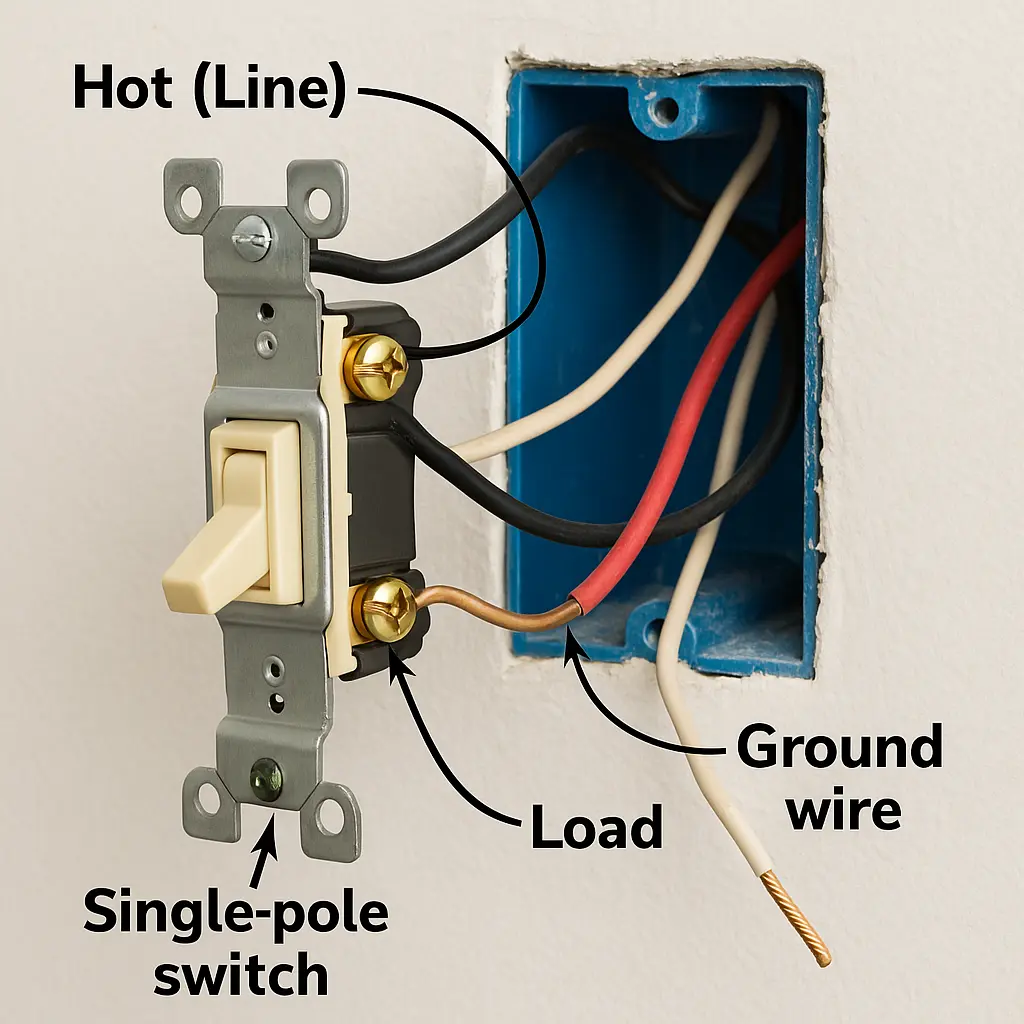
To wire a light switch correctly, you must identify these four key wires inside your electrical box:
- Line (Hot): Usually a Black wire. This brings constant 120V power from your home’s main breaker panel to the switch.
- Load: Usually Black or Red. This carries power from the switch to the light fixture only when the switch is flipped “Up.”
- Ground: A Bare Copper or Green wire. This is a critical safety path that directs electricity safely to the earth in the event of a short circuit.
- Neutral: Usually a bundle of White wires tied together with a wire nut in the back of the box.
Important Note: In a standard single-pole setup, the Neutral wires do not connect to the switch. They stay bundled together to complete the circuit back to the panel.
Types of Light Switches (Quick Overview)
Before you begin wiring, you must confirm you have the correct switch for your application. Using the wrong type can cause a short circuit or prevent the light from functioning.
- Single-Pole Switch: This is the most common type and the focus of this guide. It controls one light (or a set of lights) from one location. It has two brass screws and a green grounding screw.
- 3-Way Switch: Controls one light from two different locations (e.g., the top and bottom of a staircase). It has three screw terminals (one “Common” and two “Travelers”) plus a ground.
- 4-Way Switch: Used in large rooms where three or more switches control the same light. It features four screw terminals.
- Dimmer Switch: Replaces a standard single-pole or 3-way switch to provide brightness control. Note: Some modern LED dimmers require a Neutral (White) wire to function.
Easy Identification Tip: Look at the toggle. If it has “ON” and “OFF” printed on it, it is a single-pole switch. If the toggle is blank, it is likely a 3-way or 4-way switch.
Safety First – Before You STart Wiring
Electrical projects require strict adherence to safety protocols. Before touching any wires, follow these industry-standard safety steps to prevent electrical shock or fire hazards.
- Kill the Power at the Main Panel: Never rely on the wall switch to turn off the power. Locate your circuit breaker panel and flip the breaker for the specific room to the “OFF” position.
- Verify with a Voltage Tester: Before unscrewing the switch, use a non-contact voltage tester on the wires. If the tester glows or beeps, power is still present.
- Work in Dry Conditions: Ensure your hands are dry and you are not standing on a damp floor or near a metal sink.
- Inspect for Red Flags: If you pull the switch out and see Aluminum wiring (silver-colored instead of copper), frayed insulation, or melted plastic, stop immediately and call a licensed electrician. Aluminum wiring requires special CO/ALR rated connectors.
- Lock Out the Breaker: If you are working in a different room from the panel, tape the breaker in the “OFF” position or leave a note so no one accidentally turns the power back on while you are working.
Safety Warning: Electrical work is simple but carries inherent risks. If you are uncomfortable at any point, or if your wiring doesn’t match the descriptions in this guide, consult a professional.
How to Wire a Single-POle Light Switch
Follow these seven steps to ensure a secure, code-compliant connection.
Step 1 – Turn off the Power at the Breaker
Go to your main service panel and flip the breaker for the room. Return to the switch and attempt to turn the light on. Finally, use your non-contact voltage tester inside the box to confirm no electricity is flowing.
Step 2 – Remove The Old Switch Cover Plate
Unscrew the wall plate and the two mounting screws holding the switch to the electrical box. Gently pull the switch out by its mounting ears.
Step 3 – Identify Your Wires (Line, Load, Ground)
Look at how the old switch was connected.
- Line (Hot): Typically the black wire coming from the bottom or a separate cable.
- Load: The black (or occasionally red) wire leading to the light fixture.
- Ground: The bare copper or green wire attached to the green screw.
- Neutral: White wires (usually bundled in the back).
Note: Use a piece of electrical tape to label the “Line” wire so you don’t confuse it with the “Load” wire later.
Step 4 – Disconnect The Old Switch
Unscrew the wires from the terminals. If the wires are “backstabbed” (pushed into holes in the back), use a small screwdriver to release the tension or clip them and re-strip. Ensure you have about 3/4-inch of bare copper exposed and use your needle-nose pliers to bend a small “U-shaped” hook at the end of each wire.
Step 5 – Connect the New Light Switch
Place the wire loops around the screw terminals in a clockwise direction. This ensures that as you tighten the screw, it pulls the wire tighter rather than pushing it out.
- Connect the Ground wire to the green screw.
- Connect the Line (Hot) wire to either brass screw.
- Connect the Load wire to the remaining brass screw.
Note: For a single-pole switch, the two brass screws are interchangeable.
Step 6 – Secure The Switch Back into the Box
Gently fold the wires in an “S” shape back into the box—do not force them. Screw the switch into the electrical box, ensuring it is level. Replace the wall plate.
Step 7 – Restore Power and Test the Switch
Turn the breaker back on. Flip the switch to test the light. It should operate silently and without flickering.
When to Call A Professional
While wiring a standard single-pole switch is a beginner-friendly project, certain red flags indicate a deeper electrical issue that requires a professional. Do not attempt a DIY fix if you encounter the following:
- Aluminum Wiring: If your wires are silver-colored and labeled “AL,” they require special oxidation-resistant connectors. Standard switches are not compatible with aluminum and can create a fire hazard.
- Signs of Overheating: If you see melted wire insulation, scorch marks on the electrical box, or smell a “fishy” or burning odor, there is a serious underlying fault.
- Crowded Electrical Boxes: If the box is packed so tightly with wires that you cannot safely fold them back in, you may need a “box extension” or a larger junction box installed to meet National Electrical Code (NEC) standards.
- Unidentified 3-Way or 4-Way Circuits: If the wiring configuration doesn’t match a standard single-pole setup and you aren’t sure which wire is the “Common,” a professional can trace the circuit safely.
- Recurring Breaker Trips: If the circuit breaker trips immediately after you restore power, there is a short circuit or a ground fault that needs diagnostic tools to locate.
- No Grounding Path: If your electrical box is metal and there is no ground wire present, an electrician needs to verify if the box is properly grounded through the conduit or if a new ground needs to be pulled.
Electrical work is simple but dangerous – always choose safety first.
Common Wiring Mistakes To Avoid
Even a simple wiring job can go wrong if small details are overlooked. Avoiding these common DIY errors will ensure your installation is safe and meets building codes.
- Reversing Line and Load Wires: While a basic toggle switch will still function if these are swapped, it is best practice to keep them consistent. On “Smart” switches or dimmers, reversing these will prevent the device from working entirely.
- Creating “Long” Wire Loops: If you strip too much insulation, bare copper will be exposed behind the switch, increasing the risk of a short circuit if it touches the metal box or another wire.
- Looping Wires Counter-Clockwise: Always hook your wire clockwise around the terminal screw. This way, the loop tightens as you turn the screw. If looped counter-clockwise, the wire will often push itself out, creating a loose connection.
- Not Connecting the Ground: Never skip the ground wire. Even if the light “works” without it, the ground is your only protection against electrical shock if the switch fails or a wire comes loose.
- Over-tightening or Under-tightening: A loose screw creates heat and sparks; an over-tightened screw can snap the wire or strip the threads. Aim for “snug plus a quarter turn.”
- “Backstabbing” the Wires: Many switches have holes in the back where you can simply push the wire in. Professionals avoid this because these connections can loosen over time. Always use the side-screw terminals for the most secure connection.
Avoiding these errors ensures your new switch works safely and reliably.
Troubleshooting a Light Switch That Isn’t Working
If your switch isn’t performing as expected after installation, use this diagnostic table to identify the issue. Remember to turn the power off before investigating any of these symptoms.
|
Symptom |
Likely Cause |
Fix |
|
Light does not turn on |
Incorrect Line / Load wiring or tripped breaker |
Verify the breaker is ON; ensure the “Line” wire is on the correct terminal. |
|
Switch sparks when flipped |
Loose wire connection or a short circuit |
Power off immediately. Tighten all terminal screws and check for bare wires touching the box |
|
Light flickers intermittently |
Poor contact or damaged wire |
Re-strip the wire to ensure clean copper; ensure the wire loop is snug |
|
Switch is warm to the touch |
Overload circuit or faulty internal contacts. |
Replace the switch immediately. A warm switch indicates an internal failure or excessive amperage. |
|
Breaker trips instantly |
Ground-to-Hot short circuit |
Inspect the box. Ensure the bare ground wire isn’t touching the brass “hot” terminals. |
|
Light stays on constantly |
Faulty switch or bypass wiring. |
Replace the switch. If using a 3-way switch, ensure the “Common” wire is identified correctly. |
Final Tips for First-Time DIY Electrical Work
To ensure your first light switch installation is as smooth as possible, keep these final “pro-tips” in mind:
- Document the Original Wiring: Before you disconnect a single wire, take a clear photo of the old switch. This provides a visual roadmap if you get confused later.
- Label as You Go: Use small strips of masking tape or electrical tape to label the Line and Load wires. In a dark electrical box, two black wires look identical.
- Check the “Box Fill”: If the wires feel springy and resist going back into the box, pull them out and neatly “Z-fold” them. Never use the switch to force the wires into the wall, as this can pinch the insulation and cause a fire.
- Tighten Every Screw: Even if you aren’t using a terminal screw (like on some switches), tighten it down anyway. This prevents the loose screw from accidentally touching the side of a metal box.
- Perform a “Tug Test”: After tightening a wire around a screw, give it a firm tug. If it moves at all, it’s not tight enough.
- Don’t Over-Strip: You only need about 3/4-inch of bare copper. If the bare wire extends past the body of the switch, trim it down to prevent accidental contact with other wires.
Final Checklist: Power off? Voltage tested? Connections clockwise? Ground connected? If you can check all four, you’ve done a professional-grade job.